Diversification vs Concentration: How Many Stocks Should You Own?
On this page
Diversification is not overrated for most investors. Spreading your money across many holdings is the most reliable way to cut risk, and for the average investor it should be the default. But it can be overdone. Past a point, adding more stocks stops lowering your risk and starts diluting your best ideas. The practical question is how the risks of diversification compare with the risks of concentration.
Diversification reduces company-specific risk, but past roughly 20 to 30 well-chosen stocks the extra protection is small, while the cost in focus keeps rising. Concentration is the opposite bet - fewer names, more conviction, more risk.
In short:
- Diversification removes the risk tied to any single company. It cannot remove the risk of the whole market falling.
- Most of that benefit is captured by about 20 to 30 stocks. Beyond that, you get little extra safety.
- Concentration can raise your return potential, but it raises your risk just as much. It only makes sense if you can research deeply and stay calm through wide swings.
- The right balance depends on how well you can judge a business and how you react when one goes wrong.
What diversification actually does
Diversification means spreading your money across many investments so that no single company can do lasting damage to your portfolio. Its job is to remove unsystematic risk, also called company-specific risk - the danger tied to one business, like a product recall, a fraud or a failed launch. When you own many companies, one disaster gets averaged against everything else.
The idea has a formal name: modern portfolio theory, set out by Harry Markowitz in the 1950s. The core insight is that combining holdings that do not rise and fall together lowers the swings of the whole portfolio without giving up much expected return. The less your holdings move together, the more the rough patches cancel out.
There is a hard limit, though. Diversification cannot remove systematic risk, also called market risk - the danger that the whole market falls at once, as in a recession or a crash. No amount of spreading protects you from that. So diversification is powerful, but only against one of the two big risks you face.
For most people, broad diversification is the sensible baseline. A low-cost index fund owns thousands of companies for almost no effort, and it is hard to beat.
The risks of diversification and over-diversification
The risks of diversification show up when you overdo it. Peter Lynch coined a word for this: "diworsification" - adding holdings until the portfolio gets worse, not safer.
- Diminishing benefit. The first handful of stocks cut your risk a lot. By about 20 to 30 names, almost all the company-specific risk is already gone. Adding a 50th or 100th stock barely changes your risk.
- Diluted best ideas. If your single best investment is 1% of the portfolio, even a great outcome hardly matters. Your weakest ideas drag down your strongest ones until the whole thing drifts toward average.
- Closet indexing. Own enough stocks and you end up mirroring the index anyway, but with more cost, more tax events and more effort. You pay an active price for a passive result.
- A false sense of safety. Owning 100 stocks feels safe, but you cannot research 100 businesses well. You end up holding companies you do not understand, which is its own kind of risk.
Where the benefit runs out
The chart below is illustrative, not a forecast, but it shows the shape every diversification study finds. Start with one stock, which carries both market risk and a large dose of company-specific risk. Then add holdings and watch the company-specific part shrink.
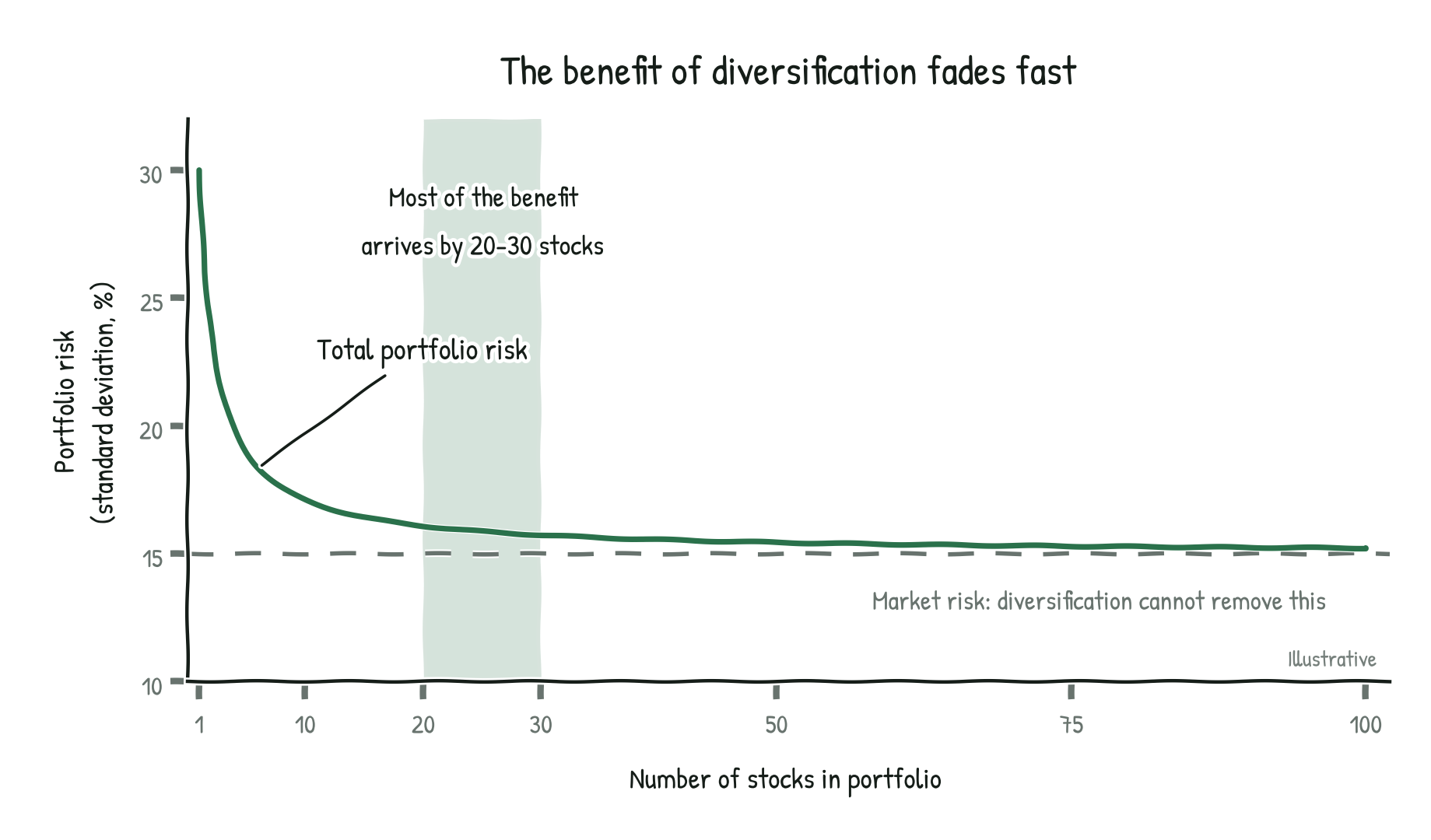
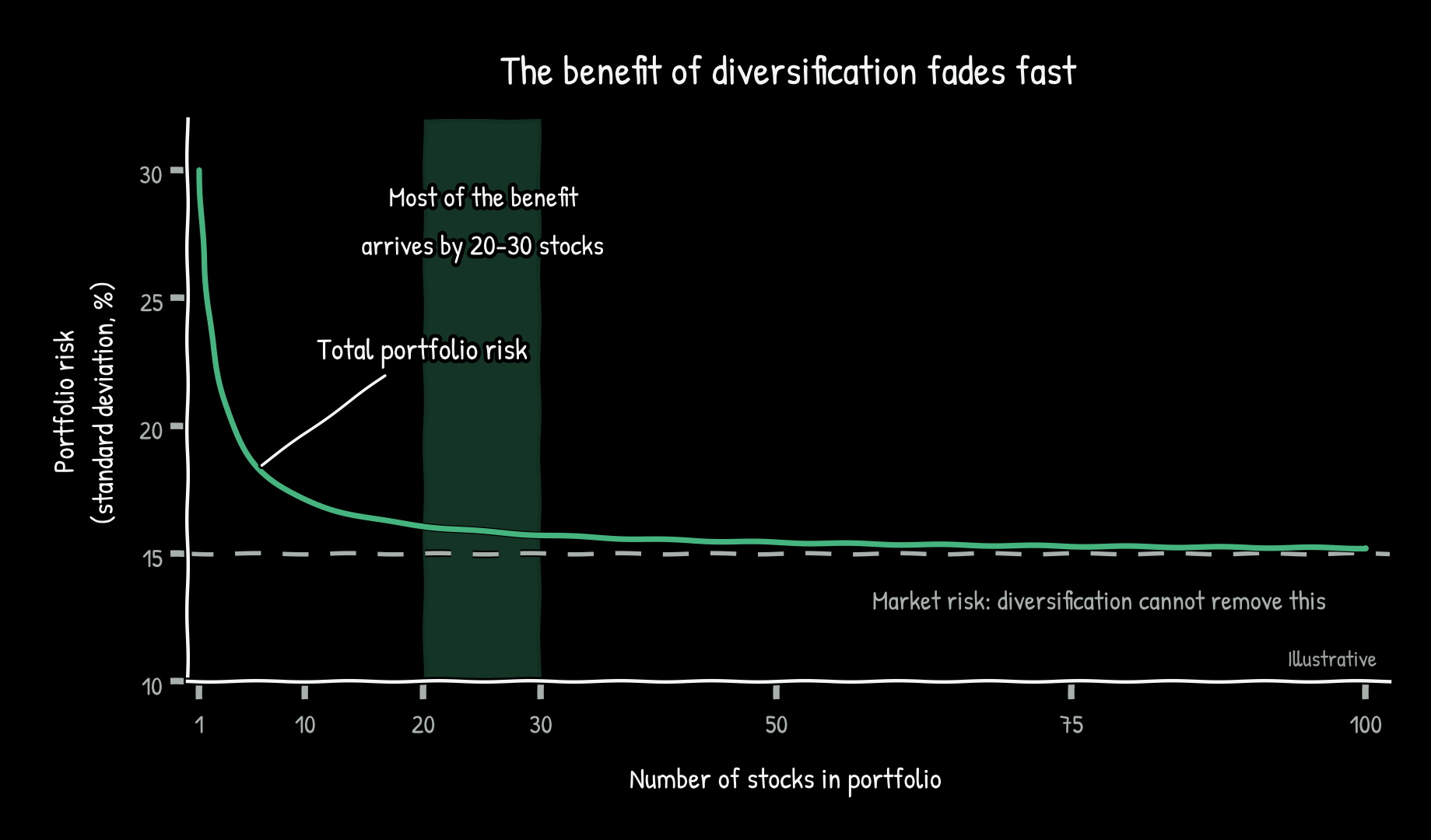
Going from one stock to 20 transforms your risk. Going from 30 to 100 mostly adds work. Each new stock protects you less than the one before, which is why "more is always safer" is wrong past a point.
The case for concentration
Concentration is the decision to put real money behind your highest-conviction, best-understood businesses instead of spreading it across many holdings.
When you own a dozen companies instead of a hundred, you can actually know them - read the filings, follow the results and understand why each one wins. "Know what you own" is hard to do across 100 names and easy across 12. Concentration also lets your best ideas matter. A great business held at 8% of your portfolio shows up in your results; the same business at 1% hardly does.
This is the tradition behind quality investing. Investors like Warren Buffett, who once said diversification is "protection against ignorance" and "makes little sense if you know what you are doing," have long run focused books of a few businesses they understand deeply. We cite that as lineage, not endorsement.
The risks of concentration
Concentration is the higher-risk path, and its costs are specific.
- It amplifies the very risk diversification removes. Company-specific risk is the thing a concentrated portfolio takes on by choice. One blowup hits much harder when it is 10% of your money instead of 1%, whether the cause is an accounting scandal, a disrupted business or a broken thesis.
- Some losses are permanent. A diversified portfolio recovers as winners offset losers. A concentrated one can take damage it never makes back if a major holding falls apart.
- It demands a steady temperament. Concentration tests your nerves. When a big position drops, it is hard to admit you were wrong, and you can end up holding a broken business far too long. The behavior is often harder than the analysis.
- Single-stock and sector traps. Concentration risk also creeps in by accident - too much in one stock through a winner you never trimmed, or too much in one sector because your best ideas cluster there.
A concentrated portfolio only makes sense for someone who can genuinely judge a business and stay calm when one goes against them. For everyone else, broad diversification remains the better default.
Diversification vs concentration: how to think about the trade-off
You do not have to pick pure diversification or pure concentration. The right mix depends on how much you know, how much time you have, your temperament and your goals.
A useful rule is to diversify across what you understand. If you can confidently judge five businesses, a portfolio of five is defensible. If you cannot confidently judge any, you should diversify widely, because you do not know which companies are durable. Position sizing gives you a middle option: hold more of your strongest ideas and less of the rest, rather than treating every holding the same.
| Broad diversification | Concentration | |
|---|---|---|
| Company-specific risk | Low | High |
| Return potential | Close to the market average | Higher, with a wider range of outcomes |
| Research burden | Low per stock, but many to track | High per stock, but few to track |
| Behavioral demand | Lower | High - you have to notice when conviction turns into stubbornness |
| Who it suits | Most investors; the sensible default | Few - those who can judge business quality and tolerate wide swings |
Diversification is not the same as asset allocation, though the two are easy to confuse. Asset allocation is how you split money across asset classes - stocks, bonds and cash. Diversification is how widely you spread within a class, such as how many stocks you hold. Allocation sets the broad mix; diversification decides how concentrated you are inside it. They are separate decisions, and you make both.
How many stocks should you own?
There is no magic number, and anyone who gives you one as advice is overreaching. What the evidence supports is the shape, not a precise count: most of the company-specific risk reduction is in place by about 20 to 30 stocks, and the benefit flattens after that.
The practical frame is this: own enough to survive being wrong about any single holding, and few enough to know each one well. The right number inside those limits is a personal call. It depends on how much research you can realistically do and how you behave when a position drops. Someone who reads 10-Ks for fun can responsibly hold fewer names than someone who checks their portfolio twice a year. Neither is wrong. They are different people making honest calls about their own capacity.
How research quality changes the trade-off
Concentration is only responsible if you can tell a high-quality, durable business from a fragile one. If you can, holding fewer names is a reasonable choice. If you cannot, concentration is gambling, and you should diversify.
That is where a systematic process helps. A rating that scores business quality the same way every time lets you hold fewer companies with more confidence, because the judgment is grounded in evidence instead of a hunch. MoatMint's Quality rating is built for this. It scores how strong and durable a business is on a 0 to 10 scale, drawing on profitability, cash generation and capital discipline. The score refreshes daily after the market closes. It is one input for your own research, not a verdict.
If you want to lean toward a focused, quality-first portfolio, these guides build the judgment it takes:
- Start by learning what durability looks like in our guide to economic moats, the advantages that let a business defend its profits for years.
- Then read how to spot high-conviction wide-moat companies - the kind of durable businesses concentration depends on.
- Use return on invested capital to gauge how well a business turns capital into profit, a core sign of quality.
- See how the full MoatMint rating helps you judge a company through a consistent lens before you size a position.
When you are ready to look for candidates, screen for high-quality businesses and confirm each one by hand. A screen surfaces candidates for research, not a buy list.
What this means for your portfolio
Diversification is the right default for most investors, and over-diversification is a real but milder mistake - mostly wasted effort and diluted ideas. Concentration is the higher-stakes choice: the potential returns are higher, and so is the cost of being wrong about a single business.
Most investors need some of both - diversified enough to survive a mistake, focused enough to own businesses they understand and patient enough to hold them for years.
MoatMint ratings and this article are for informational and educational purposes only, not personalized investment advice. Concentrating a portfolio increases risk and is not suitable for every investor.